


Zkittlez Strain: Effects, Flavour and the Phenotype Family
|
|
Time: 9 min
Product Finder
Find Your Nine Realms Match
Answer 5 quick questions to find your perfect cannabinoid product.
How familiar are you with cannabinoid products?
What kind of product are you looking for?
Where and how do you usually use cannabis?
What kind of effect are you looking for?
When should it kick in, and how long should it last?

Welcome to
Nine Realms
Our store is intended exclusively for people 18 years of age or older. Please confirm your age to continue.
By clicking here, you agree to our Terms and Conditions and Privacy Policy.
|
|
Time: 9 min
The Zkittlez strain tastes like a fistful of fruit sweets, and that's most of the reason people keep coming back to it. Indica-dominant hybrid. Flavour comes first with this one, and the effect trails in behind it, calm and body-led and perfectly capable of getting properly sleepy if you go back to the jar a couple more times than you'd planned. You'll also see it sold as Skittles, Z, or The Original Z, because a candy company took the breeders to court over the name. Same name on two jars in two shops, and you could still walk out with two different plants, since a whole sprawl of spin-offs borrowed the label. This profile pulls the classic apart from the crosses and keeps the numbers honest.
Table of Content
TL;DR: Sweet, fruity, indica-dominant. The Zkittlez strain (now officially The Original Z) tastes like candy and relaxes you, and at higher doses it leans sleepy. Published THC figures run between about 13% and 26%, so any single number you see only describes one cut.
Start with the name. It tastes like the candy, and the growers leaned into that hard. Under all that sugar sits an indica-leaning hybrid, and the Zkittlez strain built its following on flavour and an easy, mellow high. The trophies are real too. Better documented than most strain pages bother with, actually.
Attribute |
Zkittlez (The Original Z) |
Also known as |
Skittles, Skittlez, Z, The Original Z |
Type |
Indica-dominant hybrid, commonly cited around 70/30 |
THC |
About 13% to 26% depending on source and cut |
CBD / CBG |
CBD low; Leafly lists CBG around 1% |
Lineage |
Grape Ape x Grapefruit, plus an undisclosed third parent |
Credited to |
Terp Hogz and 3rd Gen Family, Mendocino County, California |
Main terpenes |
Caryophyllene, humulene, linalool, limonene (lists vary by lab) |
Flavour |
Sweet candy, grape, berry, tropical fruit, earthy base |
Effects |
Relaxed, happy, sleepy at higher doses |
Growing |
Flowering time about 8 to 10 weeks; medium yield, short to medium height |
Awards |
2015 Cannabis Cups (San Francisco and Michigan), 2016 Emerald Cup, 2023 King of Z Hill |
Read those as ranges. Every grow nudges them about, and the published sources don't always agree with each other, sometimes by a gap you'd notice the second you unscrew the lid. Where they split, we say so.
The name was always a wink at the candy. Then the wink got a lawyer. In May 2021, Mars Wrigley, the company behind Skittles, filed a trademark complaint against Terp Hogz, the Mendocino County growers behind the strain. The trademark settlement came in July 2023 with no damages paid, and Terp Hogz agreed to drop "Zkittlez" in favour of The Original Z.
So now there are three names. Breeders and the big strain databases lean on The Original Z strain, or just Z. Shops, seed banks, and most smokers still say the Zkittlez strain out of habit, the way your nan still calls a Snickers a Marathon. And plenty of you just punch "Skittles strain" or "Skittles weed strain" into a search bar, so all three keep turning up side by side.
Indica-dominant. It's usually pegged near 70% indica, and it sits firmly at the relaxed end of the shelf. The parentage is slipperier. Grape Ape crossed with Grapefruit, plus a third parent the breeders have never named. Leafly traces the original cut to a grower known as Gas Station Bob and credits Terp Hogz (Fields and Tony Mendo) and 3rd Gen Family's Brandon Parker for making it famous. Some seed banks list Dying Breed Seeds as the breeder of the seed version.
The awards hold up better than the genetics. Weedmaps lists first-place indica wins at the 2015 High Times Cannabis Cups in San Francisco and Michigan, plus a 2016 Emerald Cup win, and several other strain databases repeat the same three titles. Leafly adds a newer one. King of Z Hill, 2023. The third parent stays a blank, though, and plenty of sites paper over it with a tidy invented cross. We'd leave the hole where it is.
For a side-by-side with its peers, our best indica strains guide does the lining up. The best sativa strains guide sits at the other pole entirely. Handy if you're still working out which way you lean.
This is the part it's famous for. Crack a jar and the smell lands somewhere between a pick-and-mix counter and a fruit bowl that's been left out in a warm kitchen. Weedmaps users tag it berry first, sweet second, earthy third. Candy terps, basically. That's what people rave about.
Inhale. The taste mostly matches the smell, and on the exhale a sweet, faintly tropical note hangs about in your mouth for longer than you'd expect. Few strains get this close to pudding. For most fans that's the draw, and the strength comes a distant second.

The flavour survives the format, mostly. A dry-herb vaporiser at around 180°C shows it off best, and a joint keeps a fair share of it. Run anything too hot and you're tasting char. Sugar burns off quick.
The Zkittlez strain comes on quickly. Then it builds. First there's a gentle lift in the head, and behind that the body starts to settle, slow and a bit heavy, like sinking into a sofa cushion that turned out softer than it looked. Most people describe the same arc. It ends sleepier than the name lets on.
The numbers back it up. On Weedmaps, relaxed (46%) and happy (32%) lead the reported effects, but sleepy still makes up more than a fifth of them. Leafly's top three are relaxed, sleepy, and hungry. So it's easygoing, and it'll still sedate you if you let it.
Timing's quick. Onset lands within a few minutes of inhalation. The head-lift peaks early while the body calm builds underneath, and then the whole thing tapers off slowly over a stretch that's honestly hard to pin to a clock, because dose and tolerance shove it around so much. A first-timer and a daily smoker won't be on the same schedule at all.
The downsides are the usual suspects. Leafly users report dry mouth, dry eyes, and headaches most often, and CannaConnection adds dizziness and, for some people, anxiety or paranoia. Most of it tracks with dose. Keep a glass of water by you and slow down.
Evenings, mostly. A slow night in suits it far better than a busy afternoon with an inbox to clear. Newcomers, go easy anyway, because the flavour makes it moreish and the dose creeps up while you're busy enjoying the taste.
Moderately strong, with a wide spread. AllBud lists it as low as 13% to 15% THC, Abstrax puts it at 15% to 20%, Leafly lists around 20%, and Weedmaps reports 17% to 26%. The gap comes down to different cuts and the different labs testing them.
In practice, the Zkittlez strain made its name on terpenes, and plenty of 25%-plus strains hit harder. Hardly anybody's buying it for the number. If the figure matters to you, trust the lab certificate on the specific batch you're holding.
Small honesty problem. The published terpene lists don't agree. Leafly leads with caryophyllene (the peppery one), followed by linalool and humulene. Abstrax builds terpene blends from lab data, and its ranking puts humulene first, then limonene, pinene, and myrcene. Both can be right. Different cuts of the same name test differently.
Fair to say, then, that the sweet-fruit nose and the mellow body feel both fit a fruity mix with a peppery, earthy spine. Ratios wander. Two jars under the same label can smell oddly different, and that's why. New to terpenes? The terpenes guide covers what each one tends to do.
Most guides leave you stuck about here. The name now covers a whole family of crosses, and a few of them pull more searches than the original. You'll bump into these sooner or later.

Zkittlez also sits behind some bigger names. Cross it with Gelato and you get Runtz. That turned into a whole family of its own, and our Runtz guide and Gelato guide pick up that thread. So "I tried the Zkittlez strain" can mean any of half a dozen plants, depending on whose shelf it came off.
When a review and your own session don't line up, blame the phenotype before the batch. The name travels well. It turns up on products with only a loose claim to the actual genetics, especially in grey-market corners. A listing that names the breeder or the cut is a safer bet.
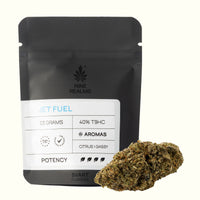
Zkittlez is now in our range. Our Zkittlez T9HC flowers sit in the PRO line at 40% T9HC and under 0.2% THC, built around the sweet, fruity profile the strain is known for. We write these profiles to help you understand a plant. Most write-ups on this one either run on hype or quietly trip over their own numbers (the THC spread above is a fair example). Ours is the boring, useful version: the ranges, and a flag wherever the sources fall out.
If you want a second sweet option to compare it with, our Gelato flower is the one to look at. If you buy anything sold as Z elsewhere, ask which cut it is. Then check the lab sheet.
The Zkittlez strain lasted for one reason: a sweet-fruit flavour few strains match. Underneath, the body effect's relaxed, sociable at low doses, and sleepy once you push it. A courtroom took the name. People still search for it under all three.
The footnote's the honest bit. THC and lineage both get reported inconsistently across the web, and the indica ratio wobbles too, depending on which database you happen to open first. Take the ranges as ranges. Check which phenotype you're holding and you'll know roughly what you're walking into.
Sweet is easy to sell — honest numbers are the harder, better part.


Indica-dominant hybrid. The Zkittlez strain is usually put around 70% indica, and it runs relaxed and body-led. Push the dose and it gets sleepier.
Somewhere between about 13% and 26% THC going by published figures, with Leafly listing around 20%. That's the moderate-to-strong band. It's known mainly for flavour, though, and individual batches can sit anywhere in that range.
Grape Ape x Grapefruit, popularised by Terp Hogz and 3rd Gen Family in California. Skittles maker Mars Wrigley filed a trademark lawsuit against the growers in 2021, and the 2023 settlement saw them rename it The Original Z.

Author: Jans Beloglazovs
Emerging from Europe's strict cannabis landscape, Jan has become a known figure in the European cannabis industry through vast experience in cannabusiness and a keen understanding of the shifting trends in Europe. Co-founding the Nine Realms cannabis brand, he leverages his expertise to advocate for progressive cannabis policies and educate a broad audience.

