


How to Use THC Syrup: Dosing and Mixing Guide
|
|
Time: 13 min
Product Finder
Find Your Nine Realms Match
Answer 5 quick questions to find your perfect cannabinoid product.
How familiar are you with cannabinoid products?
What kind of product are you looking for?
Where and how do you usually use cannabis?
What kind of effect are you looking for?
When should it kick in, and how long should it last?

Welcome to
Nine Realms
Our store is intended exclusively for people 18 years of age or older. Please confirm your age to continue.
By clicking here, you agree to our Terms and Conditions and Privacy Policy.
|
|
Time: 13 min
THC syrup is what happens when someone finally gets tired of guessing. A viscous, flavoured cannabis liquid, dropped into a drink, stirred into food, or taken straight, built for measured doses rather than eyeballing a teaspoon and hoping for the best. Onset lands somewhere between fifteen minutes and two hours, depending on the formula, and once it starts, expect it to run four to eight hours. Simple math, complicated by every brand doing it slightly differently. Its legal status in Germany depends on the specific product and the framework it's sold under, and that detail matters more than most vendors let on. This guide walks through what it actually does, how it stacks up against shots, drinks and lean, and how to dose and mix it properly.
Table of Content
TL;DR: THC syrup is a measured cannabis liquid, different from Lean or a bigger gummy in liquid form. Onset runs 15 minutes to 2 hours, duration 4 to 8 hours. The biggest mistake is redosing before it's even kicked in. New to it? Start at 2.5 to 5mg. That's genuinely the whole guide in one paragraph.
THC syrup, sometimes searched as infused THC syrup or infused syrup THC, is what it sounds like. A sugar-and-liquid base infused with THC, usually delta-9, flavoured to make dosing less of a chore than swallowing an oil or chewing through another gummy. Base ingredients vary by brand, but most formulas lean on the same backbone: sugar or fructose, a carrier like MCT oil, an emulsifier such as lecithin or polysorbate 80, and a hemp or cannabis extract carrying the active THC.
It sits in an odd middle ground. Once it's in your system it behaves like an edible, because it has to pass through your digestive tract and liver first. But you dose it more like a tincture, drop by drop or portion by portion, with a level of control a gummy simply can't offer once it's been cut into a fixed shape and size (nobody's measuring out three-quarters of a gummy bear).
Most syrups on the market fall into two camps. Classic syrup uses a standard THC extract suspended in the liquid. Nano-emulsified syrup breaks the THC particles down to a fraction of that size before infusion. Sounds technical, but it simply changes how fast your body absorbs it, which is the whole story in the next section.
Onset and duration are where most of the confusion comes from, and the explanation is simpler than the marketing makes it sound once you separate the two syrup types. Classic syrup travels through your stomach and small intestine before reaching your liver, where it's converted into 11-hydroxy-THC, a metabolite that crosses the blood-brain barrier more efficiently than the original compound ( PubMed). That conversion takes time. Expect somewhere between forty-five minutes and two hours before you feel anything, occasionally longer if you've eaten a large meal beforehand.
Nano-emulsified syrup skips a step. Because the THC particles are already broken down to a fraction of their normal size, your body absorbs them faster, sometimes through the mucous membranes in your mouth before they even reach your stomach. Onset for a well-made nano formula can land in fifteen to thirty minutes, closer to how a drink or a vape feels than a traditional edible.
Duration holds steadier across both formats. Effects build gradually rather than hitting all at once, and once they arrive, expect them to run four to eight hours, tapering rather than stopping abruptly, a pattern typical of THC syrup effects overall. That's longer than smoking or vaping, usually one to three hours, and roughly in line with any other edible format, because the liver-metabolised 11-hydroxy-THC sticks around longer than inhaled THC ever does.
Haven't felt anything after thirty minutes with a classic syrup? That's normal, not a sign the product failed. The mistake almost everyone makes is redosing during that window, then getting hit with two doses at once an hour later, a pattern well documented in clinical literature on edible cannabis use ( The Permanente Journal, 2026). Wait it out first.
Syrup is one option among several, and picking the wrong one for a given night is an easy mistake to make.
Format |
Onset |
Duration |
Dosing Precision |
Discretion |
Legal Status (Germany) |
THC syrup (classic) |
45 min – 2 hrs |
4–8 hrs |
High (mg-marked portions) |
High |
Depends on THC source and classification |
THC syrup (nano) |
15–30 min |
4–8 hrs |
High |
High |
Depends on THC source and classification |
THC drink |
10–45 min |
3–6 hrs |
Moderate (per-can dosing) |
High |
Depends on THC source and classification |
Lean-style products |
Variable, product-dependent |
Variable |
Low, historically inconsistent |
Low |
Not a regulated cannabis category |
THC shot (pharmacy) |
15–60 min |
4–8 hrs |
High, prescribed dose |
Moderate |
Prescription-only, medical framework |
Edibles / gummies |
30 min – 2 hrs |
4–8 hrs |
Fixed per piece |
High |
Depends on THC source and classification |
A few of these rows need context. THC shots sold through German pharmacies are a medical cannabis product, prescribed and dosed individually. The name overlaps with a consumer syrup bought online, but the two aren't interchangeable.
Lean-style products get their own section next, because the confusion between the two causes more mix-ups than every other row in this table combined. For context, 10 mg THC drink effects tend to land as a light, social buzz, roughly comparable to a 5–15mg syrup dose. Does a bigger bottle mean a stronger high? Only if concentration and portion marking say so, since the volume on the label doesn't determine potency.
The confusion runs deep enough that a quick search on the word "lean" points mostly toward a completely different drug. Lean, also called Purple Drank, mixes prescription cough syrup (typically codeine and promethazine) with soda and sometimes crushed hard candy. It has nothing to do with cannabis. The sedative effect comes from the codeine, an opioid.
It shares a category name with Lean, often a similar bright colour and thick texture, and that's about where the similarity ends. The active ingredient is different, THC instead of an opioid, and the mechanism is different too, cannabinoid receptor binding rather than an opioid depressing your central nervous system. Opioid-based lean carries a real overdose and dependency risk, particularly mixed with alcohol. THC syrup carries its own risks, covered in the next section, but an opioid overdose isn't one of them.
Why the mix-up persists is mostly cultural. Purple Drank got closely tied to Houston hip-hop culture through the 1990s, popularized by producer DJ Screw before breaking into the mainstream in 2000. The look of a syrupy drink in a double cup got borrowed by cannabis brands chasing a familiar visual shorthand (an association not worth chasing for the sake of a trend). Some brands lean into the naming on purpose, which only muddies things further for anyone searching a cherry thc syrup or a lean thc syrup expecting one product and finding the other.
Land here after searching for Lean and you're not alone. It's a genuinely common mix-up, and worth clearing up before it causes someone to underestimate a codeine-based product because they assumed it was cannabis.
Dosing by teaspoon or millilitre is how most people get it wrong. Two bottles with the same serving size can carry wildly different THC content, so the unit that actually matters is milligrams.
Experience Level |
Suggested Starting Dose |
Notes |
New to THC |
2.5–5mg |
Wait at least 2 hours before considering more |
Occasional user |
5–15mg |
Still allow a full onset window before redosing |
Experienced user |
15–30mg |
Higher doses raise the risk of unwanted intensity, not just a stronger version of the same effect |
This is also where the "how strong can it get" question comes up, usually phrased as a search for syrup in the triple digits, thc syrup 500mg, 1000mg, sometimes higher. The same grey-market pattern shows up in 100 mg THC drinks and a 500mg THC drink, sold with no reliable way to measure a single portion. Products marketed at that potency exist, mostly through unregulated or grey-market channels. A bottle that size can hold enough THC for dozens of doses, with nothing on the label telling you where one ends and the next begins. A d9 thc syrup dosed in clearly marked 30mg portions solves a different problem than one boasting the biggest number it can print. It's a simple principle: precision beats potency once you're the one deciding how much to take.
THC syrup's delayed onset is also its biggest safety risk. The compound itself isn't unusually dangerous; the risk comes from people redosing before the first dose has even finished arriving. Waiting is the least glamorous advice in this entire guide. It's also the advice that prevents the worst nights.
A few combinations are worth flagging specifically:
None of this is medical advice. If you're on regular medication, a pharmacist knows more than a blog post ever will. The redosing mistake alone explains most of the bad experiences linked to THC syrup, and it's entirely avoidable.
Mixing it into a drink or a recipe is exactly what most people buy it for, and getting the ratio right matters more than the mixing method itself.
Treat the syrup as the entire dose first, then build the drink or dish around that measured amount. Use the markings on the bottle rather than a free pour, and mix it into a glass of juice, a mocktail, iced tea, or even coffee. It dissolves into most liquids without much stirring.
Manufacturer guidance varies by product though, so check the specific bottle in front of you. Some formulas are built and tested for a particular mixer (water, most often) and recommend against sugary drinks specifically, because they can mask the dose. Chasing a full THC syrup recipe from scratch is a DIY path some people take, but pairing an already-tested syrup with a drink you already like is simpler and safer.
Heat is worth being careful with. THC starts to degrade at high temperatures, so folding syrup into a hot dish or baking it directly costs you potency. If you're using it in food, add it after cooking, once the dish has cooled to a safe eating temperature, the same rule that applies to any THC-infused ingredient.
A few practical notes for mixing:
However you mix it, the dose in the bottle doesn't change once it's in the glass. Diluting it in a larger drink doesn't reduce the THC. It just spreads the same amount across more liquid.
A Certificate of Analysis (CoA) is the one document that turns a THC content claim from a marketing number into something verifiable. Most buyers never think to ask for it, understandably; nobody wants to be the person emailing a stranger about lab reports.
A proper CoA comes from a third-party lab, not the brand itself, and lists the actual cannabinoid content per portion or per bottle, tested against what the label claims. Reputable sellers make this easy to find, usually through a QR code on the packaging or a link on the product page. A brand that can't produce one is worth treating with suspicion.
Not everything on a CoA carries equal weight.
Products without any published testing aren't automatically unsafe. They're an unknown. And precise dosing is supposed to eliminate exactly that.
Nine Realms is bringing SVART THC Syrup to the range, built around the exact problem this guide has spent the last few thousand words walking through: dosing that doesn't rely on guesswork.
SVART is a real Delta-9 THC product. Most of the Nine Realms catalogue uses T9HC instead, and that distinction is worth stating plainly rather than letting it blur.
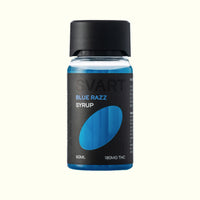
Delta-9 THC concentration sits at 0.3%, across three flavours, Blue Razz, Vanilla, and Cherry, each in a 60ml bottle carrying 180mg of D9 THC total across six marked doses of 30mg each. Shake it before use, the formula settles, and the graduated markings mean you measure a portion against a line on the bottle rather than guessing. It's vegan and full spectrum, built on a straightforward syrup base: sugar, fructose, water, MCT oil, lecithin, hemp infusion, citric acid, and food colouring. Nine Realms recommends mixing it with water specifically. Sugary drinks aren't recommended, since they mask the dose and make it harder to judge how much you've actually had.
That 30mg-per-portion structure is a deliberate choice. Search around and you'll find syrups marketed at 500mg, 1000mg or more per bottle, most with no reliable way to measure out a single dose. SVART collection goes the other way. A smaller, clearly marked portion, designed to be dosed accurately, closer in spirit to the start-low-go-slow advice covered earlier in this guide than to a bottle built to advertise a big number on the label.
Legal status depends on where you are and how the product is classified, the same as with any THC product, and that's worth checking against current German regulations rather than assuming it either way.
Precision isn't usually the selling point brands lead with. Bigger numbers are easier to market than smaller, more honest ones, and a bottle boasting 1000mg will always look more impressive on a shelf than one clearly marked in 30mg portions.
Nine Realms' position here is straightforward. A dosing claim only means something once it's been tested. A table full of neat numbers is worthless if the product behind it can't be measured accurately in the first place.
That holds whether or not someone ever buys a bottle. The goal is making sure that whoever tries it can decide with real numbers in front of them.
THC syrup solves a real problem. Most cannabis formats make dosing harder than it needs to be, and syrup, done properly, makes it easier. Confusing it with Lean, a THC drink, or a pharmacy shot misses the point of it entirely, portion control.
What actually matters comes down to two things: whether you can measure a dose accurately, and whether you wait for it to take effect before assuming it hasn't worked. A close third, checking that the product behind the label has been tested by someone other than the brand selling it. Flavour, format, whether it's taken straight or mixed into something else, all of that is preference once those are covered.
Milligrams beat teaspoons.
"A syrup marked in milligrams tells you more than one boasting in triple digits."
No. Lean, also called Purple Drank, is a codeine-and-promethazine cough syrup mixture with no cannabis involved. THC syrup works through a completely different mechanism, with a different risk profile, and the two only share a nickname and a similar look.
Look for a Certificate of Analysis (CoA) from a third-party lab, usually linked through a QR code or a product page. It should list cannabinoid content per portion and carry a batch number that matches the bottle in front of you, tied to that specific batch rather than reused across the whole product line.
Classic syrup usually takes forty-five minutes to two hours. Nano-emulsified versions absorb faster, often within fifteen to thirty minutes. Waiting out the full window before considering more is the single most useful habit you can build here.
Somewhere between 2.5mg and 5mg is a reasonable starting point if you're new to THC. Give it at least two hours before deciding whether to take more.
It's not recommended. Alcohol raises THC levels in your blood and intensifies its effects, and combining the two raises your risk of nausea and dizziness well beyond what either causes on its own.
In Germany, a THC shot bought through a pharmacy is typically a prescribed medical cannabis product, dosed individually by a physician. A consumer syrup is a retail product you dose yourself, and despite the name overlap, the two aren't interchangeable.
Author: Jans Beloglazovs
Emerging from Europe's strict cannabis landscape, Jan has become a known figure in the European cannabis industry through vast experience in cannabusiness and a keen understanding of the shifting trends in Europe. Co-founding the Nine Realms cannabis brand, he leverages his expertise to advocate for progressive cannabis policies and educate a broad audience.


